2023 · Horror · Puzzle · Interactive Fiction
How long isKiller Frequency?
by Team17
7 hours
for the typical playerhalf of them between 5.5 hours and 9 hours
Killer Frequency among the 761 puzzle games here
The whole tier list#492
of 761
ranked by owners here who played past two hours
- 29%
- got past 2 hours
- −9 on the kind's 38%
- 1%
- past 20 hours
- about the kind's 3%
- 47%
- launched it
- −10 on the kind's 57%
- 68
- libraries own it
- 1 in 36 of the 2,472 read here
Next to it in the ranking
Pricey for its length: $3.57 an hour, dearer than 765 of 1,033 puzzle games here.
50% recommend it at 0 to 2 hours
87% recommend it at 2 to 5 hours
97% recommend it at 5 to 10 hours
98% recommend it at 10 to 20 hours
Does Killer Frequency hold up?
Grows on people
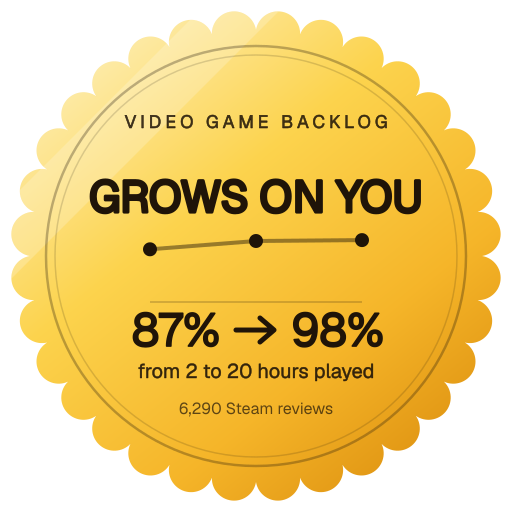
87% of its Steam reviewers recommend it at 2–5 hours played, and 98% at 10–20 hours played.
Earned when the share recommending a game rises 8 points or more from its first stage past the two-hour mark to its last, never falls 5 points on the way, and at least 80% of all its Steam reviewers recommend it. Every game that holds it.
Do the first two hours of Killer Frequency tell you?
In the first two hours50%recommend it
After that95%recommend it
7 in 100 said no: 4 after the window had closed, 3 while a refund was still possible.
How this is counted
Half of its Steam reviewers had played 7 hours or less when they gave their verdict. The middle half sat between 5.5 hours and 9 hours.
One token is 1% of its Steam reviews, standing at the hours its author had played. Counted from about 6,290 Steam reviews, by the hours each author had played when they wrote theirs. It is not a time to beat.
It grows on people: 87% recommend it at 2–5 hours, and 98% at 10–20 hours.
5% of its reviews were written inside Steam's two-hour refund window, and 50% of those recommend it. After the window, 95% do. Of the players who gave it a thumbs-down, 63% were already past the window; the typical thumbs-down came 3 hours in.
When would you get there?
7days
At an hour a night, you’d pass the typical player’s 7 hours on Friday, November 20.
Half of its reviewers had played between 5.5 and 9 hours: Nov 19 to Nov 22 at this pace.
How this is counted
The typical player's hours are the hours Steam reviewers had played when they wrote their review, not a time to beat. The days count from today, playing the hours the pace says on each day.
Where do players get filtered in Killer Frequency?

The filter
Let There Be Light
4 of every 100 players got to this one and no further.
They hold From Beyond The Grave and never earned it.


How this is counted
47% of the players who launched Killer Frequency hold Let Me In, its first story achievement on Steam, and 41% hold The End?, its last. The steepest drop comes between From Beyond The Grave (45%) and Let There Be Light (41%).
Steam's global achievement stats count everyone who ever launched the game, people still playing included. They are not a finish rate. The filter is the steepest drop between two story achievements; the players who never reached the first one barely started, and are never the filter.
Is Killer Frequency worth it?
Video Game Backlog
One hour, at list price
Killer Frequency
- Steam list price, US
- $24.99
- Typical player
- ÷ 7 h
- puzzle game rate
- $2.28/h
- 7 h at that rate
- $16
List price. Not a sale price,
not what anyone paid.
Is Killer Frequency worth it? It depends.
Pricey per hour
A typical puzzle game gives 1.6× the hours for the money
Loved
95% recommend it after the refund windowmost puzzle games: 92%
Often left unplayed
47% of owners here have played itmost puzzle games: 63%
How this is counted
At Steam's US list price of $24.99, the typical player's 7 hours come to $3.57 an hour. Past the two-hour refund window, 95% of its Steam reviewers recommend it. At $3.57 an hour, Killer Frequency costs more per hour than 765 of 1033 puzzle games here: the typical one of 1033 puzzle games here charges $2.28.
The price is Steam's US list price for the game by itself: not a sale price, a bundle or what anyone paid. The hours are the ones its reviewers had played, not a time to beat. Its kind (puzzle games) is what the game is first, as a model that knows games named it once from a list of Steam's kinds (for a game it did not know, its strongest Steam tags name it), among the kinds with at least 20 priced games here; failing that, by its Steam genre. The going rate is the middle hourly cost of those games, and the receipt prices its typical hours at it. The words beside it compare it with its kind: loved is 90% recommending it or more, liked 80%, mixed 65%; it gets played when a quarter fewer of the owners read here never launched it than of its kind's typical game. Whether it holds up is drawn on the hours road above, and counts toward the one-word answer.
Where can I play Killer Frequency today?
Almost anywhere
PC, PS5, Xbox Series, Switch and 2 more.
- todayPC2019
- todayXbox Series2023
- todayPS42023
- todayPS52023
- todayXbox One2023
- todaySwitch2023
How this is counted
From IGDB, found by its Steam app: the machines Killer Frequency came out on and the year it first reached each, and the collections, ports, remasters and remakes that carry it. A machine counts for today while it, or the one after it, still plays its games and its store sells them: Switch, PlayStation 4 and 5, Xbox One and Series, PC and phones. A PC release from before 2005 counts as gone, unless Steam sells it. IGDB does not say when a store stopped selling a release, so a delisted one can still show here.
Would you like Killer Frequency?
Give the ball your Steam profile link or name. It reads the games you own most like Killer Frequency, how long each held you against the typical player, and how long Killer Frequency would take you. Public profiles only. No account needed, and no library is saved.
How this is counted
It reads how long you tend to stay: across every game you've played whose typical hours it knows (free games left out), how often you went past the typical player and how often you left before half their hours. It glows when you often stay past them, dims when you often leave early, and needs five played games to read at all. Then it shows the games you own most like this one, by the same measure as the shelf of games like it, each with your hours against the typical player's.
Why not a forecast for this game: on 36,766 Steam libraries, how a player did on games like one told little beyond how long they stay in games at all, so those games are shown as evidence and never scored. Nothing of the library is kept.
@you holds this page
- 1st
 @you2.2 h
- 2ndopen– – –
- 3rdopen– – –
Public pages here, by the hours Steam has on this game. From two hours up, the most hours holds the page.
What did people here do with Killer Frequency?
1 in 726
Name 100 runs say its name: players asked to name 100 games from memory
How this is counted
Counted from the Steam libraries read here and the pages kept here, not from all of Steam's players. A case is one owner, or one in twenty of them when there are more.
Games like Killer Frequency
Stories Untold
Killer Frequency, but told in text, and half the hours
Liked · 87%Games like Stories Untold
The Stanley Parable: Ultra Deluxe
Killer Frequency, but psychological horror, and 3D
Loved · 94%Games like The Stanley Parable: Ultra Deluxe
Not For Broadcast
Killer Frequency, but a job sim, and dystopian
Loved · 94%Games like Not For Broadcast
Friday the 13th: Killer Puzzle
Killer Frequency, but free to play, and a third of the hours
Loved · 94%Games like Friday the 13th: Killer Puzzle
How this is counted
Its own series apart, where it plays alike; then the games sharing the most of its strongest Steam tags, genres and themes, the better known ahead among the about as alike. A model that knows games read the list once: the ones it said do not play like this game are left out, the closest come first. Under each name, what sets it apart from Killer Frequency: a kind of game it is that Killer Frequency is not, a feature its tags carry that Killer Frequency's barely do, how many hours people play it, how its reviewers feel. Each case wears the hours its own page leads with.